

Students from across Europe recently explored how countries cooperate over shared rivers in a webinar led by SIWI’s Dr Martina Klimes. Through debate and negotiation exercises, the session introduced key principles of water diplomacy and transboundary water management, highlighting the importance of building understanding of shared waters at all levels of education.
Students from secondary schools across Europe recently explored one of the world’s most complex water challenges: how countries share rivers.
In a webinar led by Martina Klimes, PhD from SIWI, students discussed how nations manage shared water resources and how water diplomacy helps transform potential conflicts into opportunities for cooperation. The session also prompted many insightful and highly relevant questions from students, underscoring both the complexity of the topic and the strong engagement it generates.
Across the world, hundreds of rivers cross national borders. Managing these shared waters requires dialogue, trust, and negotiation, the core principles of water diplomacy.
SIWI has long worked on water diplomacy and transboundary water cooperation, supporting dialogue, research, and practical tools that help countries manage shared water resources peacefully. Through initiatives on water and peace, SIWI contributes expertise to policymakers, practitioners, and international processes working to strengthen cooperation around shared waters.
The seminar formed part of the “WaterWise” education programme organized by Schools Beyond Regions and Borders (SBRB), which connects classrooms across Europe to discuss global challenges. Students from Austria, Bosnia and Herzegovina, Germany, Ireland, Italy, Latvia, Portugal, Slovenia, Spain, and Sweden took part.
Understanding shared rivers
Many rivers, lakes, and aquifers are shared by multiple countries. Decisions made upstream can affect communities far downstream, shaping access to water for agriculture, energy production, ecosystems, and livelihoods.
Water diplomacy provides tools to manage these shared resources peacefully and effectively. By bringing together scientific knowledge, policy dialogue, and stakeholder perspectives, it helps countries move beyond disputes over ownership toward identifying shared interests and cooperative solutions.
Rather than focusing only on dividing water, water diplomacy encourages countries to identify shared benefits, such as improving food production, generating renewable energy, reducing flood risks, or protecting ecosystems.
From conflict to cooperation
To help students understand these dynamics, teachers prepared classroom exercises based on a fictional scenario known as the “Blue River crisis”.
In the scenario, two countries share a river. The upstream country plans to build a dam to generate electricity for its growing population, while the downstream country depends on the river to irrigate farms and sustain its food production.
Students first debate their country’s position, defending competing needs around energy, development, and water access. They then move from confrontation to negotiation, working together to design agreements that both sides can accept — such as guaranteed minimum water flows, shared dam management, or electricity-sharing arrangements.
The exercise highlights a central principle of water diplomacy: conflicts over water are rarely about one side being right or wrong. Instead, they involve balancing legitimate needs across borders.
Building skills for future cooperation
Through the simulation, students explored key concepts including upstream and downstream dynamics, water scarcity, and the economic importance of rivers. They also practiced skills central to diplomacy: critical thinking, negotiation, and understanding perspectives different from their own.
The programme also encourages students to examine real-world river basins such as the Nile, Mekong, Colorado, and Danube to understand how countries cooperate in managing shared waters.
Connecting knowledge and practice
For SIWI, initiatives like this highlight the importance of making complex water governance challenges accessible to wider audiences.
Water diplomacy plays a growing role in addressing global challenges linked to climate change, food security, and regional stability. Introducing these issues in classrooms helps build awareness of the cooperative approaches needed to manage shared water resources in the future.
At its core, water diplomacy is about transforming a shared natural resource into a platform for dialogue and collaboration. As Martina explained to the students, rivers can be sources of tension, but they can also become bridges between countries.
Explore the teaching materials
Teachers and educators can download the lesson plan, classroom exercises, and role-play materials used in this session to introduce students to water diplomacy and transboundary water cooperation. Click HERE.
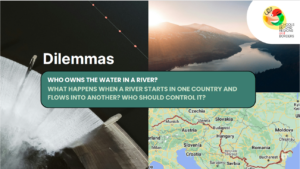

Explore the teaching materials
Teaching materials: Water diplomacy – Turning rivers into bridges
- Water and climate
- Water governance
- Water in landscapes

- Water-smart business
- Swedish Water House

- World Water Week

- Transboundary Water Cooperation
- Water and climate
- Water governance