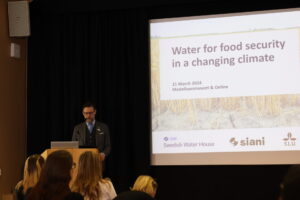


The annual Swedish Water House trend-spotting meeting brought together a selected group of decision-makers under the Chatham House Rule. Participants represented Swedish authorities, organizations, companies, and academic institutions, and met at a time of accelerating climate impacts, geopolitical shifts, and growing uncertainty around existing governance frameworks.
Against this backdrop, participants explored how water is increasingly emerging as a decisive factor in climate adaptation, economic stability, and societal resilience.
The discussion highlighted a growing gap between the pace of hydrological change and the systems designed to manage water-related risks. While awareness of water’s importance is rising across sectors, governance structures, investment models, and decision-making processes have struggled to adapt to a rapidly changing hydrological cycle. For the private sector and financial actors in particular, this mismatch is becoming a material risk — but also a source of new opportunity.
Emerging themes from the discussion
A changing global context: governance, risk, and uncertainty
Participants noted a broader shift in the global operating environment. Trust in multilateral institutions is declining, protectionist tendencies are increasing, and traditional global processes are delivering results more slowly than the pace of climate and nature-related impacts. This has direct implications for water governance, which relies heavily on coordination across borders, sectors, and levels of decision-making.
At the same time, new alliances and coalitions are emerging, often driven by practical needs rather than formal mandates. In this context, water is increasingly framed not only as an environmental or development issue, but as a strategic risk factor linked to security, trade, supply chains, and social stability. This reframing is particularly relevant for business and finance, where water-related disruptions are already affecting production, sourcing, investments, and long-term planning.
Water as a strategic and economic factor
A central theme of the discussion was the persistent under-valuation of water. Despite being foundational to all economic activity, water is rarely priced or accounted for in ways that reflect its true value. This limits incentives for efficiency, innovation, and long-term stewardship.
The framing of water as the currency of the planet captured a shared concern: without mechanisms to recognize water’s economic and strategic importance, decisions across policy, finance, and business will continue to underestimate water-related risks. Unlike carbon, which can be priced globally, water is local, variable, and context-specific — making valuation more complex, but no less necessary.
Participants highlighted the growing need to integrate water more systematically into risk assessments, business strategies, and financial decision-making. For many companies, water risks remain difficult to access through existing sustainability assessments, which often rely on aggregated or outdated data that fails to capture conditions at the watershed level.
Climate change and the shifting hydrological cycle
Recent droughts and extreme events were seen as clear signals of a changing hydrological cycle. In Sweden and beyond, the shortening intervals between severe water-related events point to a new normal in which historical assumptions no longer hold.
These changes have far-reaching implications for agriculture, industry, and trade. Global supply chains are increasingly exposed to water stress in key sourcing regions, while domestic systems face mounting pressure to adapt to variability rather than averages. Participants noted that climate adaptation strategies often lag behind these realities, focusing on incremental improvements rather than systemic change.
Water in the international climate and UN context
In addition to the discussion themes, SIWI situates the 2026 trendspotting in a broader international policy context. The year 2026 represents a unique moment for water in the global climate and development landscape.
All three Rio Convention COPs (UNFCCC, UNCBD, and UNCCD) will take place in the same year, with water acting as a critical connector across climate, biodiversity, and land agendas. 2026 will also mark the second UN Water Conference after an almost 50-year gap, alongside a formal review of Sustainable Development Goal 6 on water and sanitation at UN Headquarters in New York.
While water has not consistently featured at the top of the international climate agenda, there are indications of growing recognition. Under the Global Goal on Adaptation, nine out of ten proposed water-related indicators were adopted, signalling a shift towards more concrete treatment of water in adaptation efforts. At COP30, countries also agreed to efforts to at least triple adaptation finance by 2035, although implementation details remain unclear.
In Sweden, attention is increasingly shifting towards implementation of national climate commitments. This includes a stronger focus on the role the private sector can play in delivering solutions and supporting implementation. This solution-oriented approach offers opportunities to inspire new forms of collaboration and reinforces the view of climate and water transition as a business opportunity.
Green water, land use, and adaptation
Green water — the water in soils and landscapes — emerged as a critical but under-recognized component of climate adaptation. While agriculture and water policy tend to focus on irrigation and blue water, participants stressed that green water accounts for a significant share of hydrological flows and plays a decisive role in resilience.
Integrating the green water perspective into decision-making remains challenging. It is less tangible, harder to measure, and often sits outside established governance frameworks. Yet its relevance is growing as climate impacts intensify. Participants also pointed to the need to better align land use, consumption patterns, and sourcing strategies with changing water realities — including reassessing dependencies on water-stressed regions and exploring more resilient production models closer to home.
The role of the private sector and value chains
The private sector is widely seen as a key stakeholder for change. Many companies are already experiencing water-related risks and are moving faster than public institutions in integrating cross-sectoral perspectives. Collaboration — including between competitors — was identified as a particularly effective way to advance water standards, share risk, and reduce transaction costs.
Sourcing was highlighted as an increasing challenge as vulnerability grows and the frequency of climate-related events rises. Updated water roadmaps, including joint efforts with competitors, were seen as important hedging approaches in response to this uncertainty. Rather than pursuing ownership or control of sourcing locations, purchasing agreements were identified as a more effective lever to establish better practices, enable new technologies, and safeguard supply chains. Through stronger corporate governance, such approaches were also seen to attract investment and improve the bankability of water-related projects.
At the same time, companies face structural barriers. Water is often treated as a compliance issue rather than a strategic asset, limiting incentives for innovation and scale. Participants stressed that technical solutions alone are not sufficient; understanding and acting on low-hanging opportunities to preserve water within processes — and to keep water at its source — was seen as critical to shifting how water is perceived, from a regulatory constraint to a driver of value creation.
A systematic approach, long-term value chain agreements, clearer policy signals, and stronger links between water, energy, and resource efficiency were identified as critical enablers for moving from risk awareness to operational and investment-ready solutions.
Finance, data, and bankability
A recurring theme was the disconnect between available capital and investable water solutions. Public funding alone is insufficient to meet the scale of investment required, yet private capital often struggles to engage due to data gaps, fragmented risk assessments, and weak pricing signals.
Participants emphasized the need to translate water challenges into financial language — focusing on risk, resilience, and long-term value creation. Robust, trusted data at the watershed level was seen as essential, both for risk assessment and for building investor confidence. At present, data is often outdated, inconsistent, or poorly aligned with decision-making needs, making it difficult to scale solutions beyond pilot projects.
Beyond traditional project finance, new financial instruments and bridge financing were highlighted as important tools for enabling long-term investments in water, climate, and nature. Mobilizing capital will depend on reframing water through the lens of value creation rather than compliance alone, while aligning investment horizons with the long-term nature of water-related risks and returns.
Participants also noted that while investors and companies increasingly demand granular data and clear KPIs, municipalities often operate under funding models that do not yet require or enable such data generation. At the same time, uncertainty around CSRD requirements and wider debates about data credibility were acknowledged. Despite this, many companies are actively seeking to move beyond compliance, driven by risk management and long-term value considerations.
From pilots to systems: innovation and implementation
Innovation in the water sector is not lacking, but deployment and scaling remain major challenges. Low or zero water pricing weakens market incentives, while human resource constraints limit operational capacity. Competition with other sectors for skills further compounds the problem.
Participants highlighted that governance and institutional rigidity often present greater barriers than technology itself. Fragmented responsibilities, outdated management approaches, and regulatory misalignment were seen as limiting uptake and scale. At the same time, significant investments in treatment infrastructure are underway, and opportunities exist to combine water solutions with innovations from other sectors, such as advanced sensor technologies. With climate innovation already high on the private sector agenda, water is increasingly entering this space as a strategic priority.
Scaling solutions will depend not only on new technologies, but on governance reform, workforce development, and closer alignment between public and private actors — particularly at the level where implementation decisions are taken.
Implications for action
The discussion also highlighted the growing relevance of the nature–security nexus. Water and ecosystems were seen as central to resilience and preparedness, particularly in the Swedish context of preparedness. Participants encouraged a broader understanding of resilience that goes beyond acute crises and incorporates long-term environmental risks.
The discussions point to several implications for business, finance, and policy:
- Water must be treated as a strategic risk and value driver, not a peripheral sustainability issue.
- Climate adaptation efforts need to place water — including green water — at their core.
- Private sector collaboration across value chains can accelerate progress where public processes are slow.
- Financial actors require better data, clearer signals, and bankable models to engage at scale.
- Governance frameworks must evolve to reflect the realities of a changing hydrological cycle.
Water connects climate, nature, trade, equality, and security in ways few other issues can. Recognizing and acting on this interconnectedness will be essential for building resilient societies and economies in the years ahead.





- Water and climate
- Water governance

- Water and climate

- Water governance