
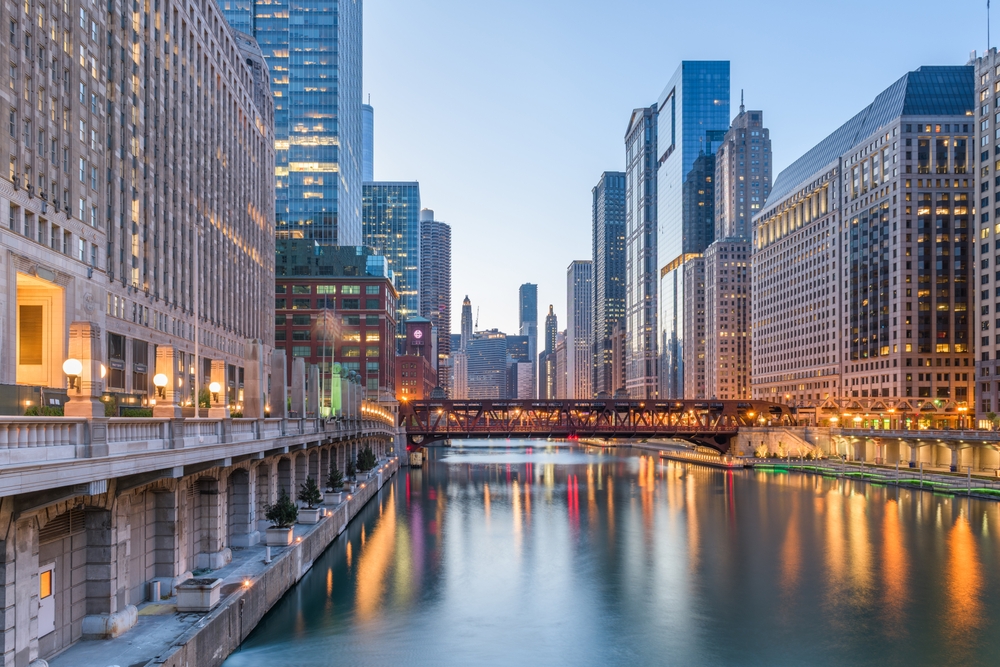
At the 2026 Society of Environmental Journalists conference in Chicago, SIWI worked with reporters to explore how water shapes the stories they already cover—from climate and land use to infrastructure and governance—and why that matters in a year of major global water decisions.

As water rises on the global agenda, how it is reported is starting to matter just as much as what is decided.
Last week, SIWI joined the Society of Environmental Journalists annual conference, held in Chicago this year, to engage directly with reporters on how water appears—often invisibly—across climate, land, and policy stories. The aim was not to teach journalism, but to offer a practical lens for identifying the water dimension in stories that are already being covered.
This comes at a critical moment. In 2026, water is moving to the centre of international discussions on climate adaptation, food systems, economic resilience, and security. Major global processes later this year, including World Water Week, COP31 and the UN 2026 Water Conference, are expected to shape how countries respond to growing water-related risks.
A practical lens for reporting
At the conference, SIWI’s Andrea Norgren led a workshop titled Strengthening Your Water Stories – Signals to Follow in 2026, working with environmental journalists to test how water can change the way stories are framed.
The session introduced three investigative signals:
- What is the water story behind climate change?
- What happens to water when we change the land?
- Who decides who gets water when it is shared?
Rather than presenting water as a standalone topic, the approach positioned it as a connective layer—linking issues such as energy, agriculture, urban development, and economic policy.
For many reporters, this means shifting from seeing water as a sector to recognizing it as a system. Droughts, floods, and changing rainfall patterns are often how climate change is experienced in practice, yet these impacts are not always framed as water stories. Similarly, land use decisions—from agriculture to urban expansion—can reshape water availability and even influence rainfall patterns, often without being reported as such.
The workshop focused on practical application. Journalists were invited to revisit recent stories and identify where a water angle may have been missing, and to develop new story ideas using the three signals as a guide.
From local crisis to global signal
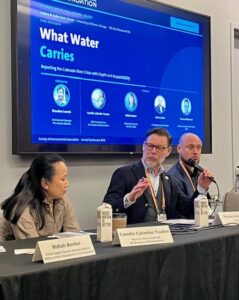
SIWI also contributed to a high-level panel discussion on reporting the Colorado River, a major river system in the southwestern United States supplying water to tens of millions of people.
The discussion focused on how long-standing assumptions about water availability no longer hold. SIWI’s Thomas Rebermark brought an international governance perspective to the conversation, alongside representatives from government, Indigenous leadership, and data analysis.
The session explored how one of the world’s most closely watched water systems is being reported—and what it reveals about wider governance challenges.
While much coverage focuses on reservoir levels, drought conditions, and allocation disputes, the discussion highlighted a deeper issue: water governance is often fragmented across institutions, sectors, and scales. Climate frameworks, infrastructure planning, land management, and financing mechanisms frequently operate in parallel rather than as part of a connected system.
This fragmentation shapes the way stories are told. When governance is divided, reporting often follows the same pattern—focusing on individual decisions, events, or data points, rather than the underlying system.
The panel positioned the Colorado River not only as a regional story, but as a signal of broader global challenges. Many water agreements around the world are based on historical assumptions about availability that no longer hold. As conditions shift, systems designed for a different hydrology are being forced to operate beyond their original limits, raising questions about accountability, equity, and long-term sustainability.
Supporting stronger water reporting
Across both sessions, a common theme emerged: some of the most important water stories are already being reported—but not always recognized as such.
By offering frameworks, data access, and connections to experts, SIWI works to support journalists in strengthening how these stories are developed and communicated.
This engagement continues beyond the conference. Through the Water in Communications programme at World Water Week, SIWI works with journalists, policymakers, and practitioners to strengthen how water issues are understood and reported across sectors.
SIWI’s participation at the Society of Environmental Journalists conference was supported by the Grundfos Foundation, which also supports the Water in Communications programme at World Water Week—helping to connect this work with a broader global community of journalists and decision-makers.
As global attention turns to the major water and climate milestones ahead, the role of journalism in shaping understanding—and accountability—will only grow.


- Indigenous knowledge
- Water governance
- Water and climate
- Water cooperation

- Water and climate
- Water governance
- Water in landscapes
- Water-smart business
- Swedish Water House