







Stay informed
SIWI newsletter
Receive SIWI’s latest news, events, reports and jobs directly in your inbox.
You can unsubscribe at any time.



The water cycle begins as water evaporating from oceans, lakes, soils, and leaves, rising into the atmosphere and traveling—sometimes thousands of kilometres—before falling again as rain or snow. This great atmospheric conveyor belt of moisture is essential for crops, rivers, hydropower, and the health of entire ecosystems. It also underpins the security and well‑being of billions of people.
A major portion of this journey happens over land. Globally, about 45% of all precipitation originates as evaporation or transpiration from land surfaces, a process called terrestrial moisture recycling (TMR). This “green‑water” flow includes moisture released by forests, grasslands, wetlands, and croplands—but not all landscapes contribute equally.
A growing body of evidence shows that Indigenous Peoples’ lands (IPL)—territories stewarded for generations—play an outsized role in maintaining ecosystem functions, biodiversity, and climate stability. Indigenous lands cover at least 38 million km², accounting for roughly 40% of the world’s ecologically intact ecosystems. But until now, their role in generating and recycling atmospheric moisture had never been quantified.
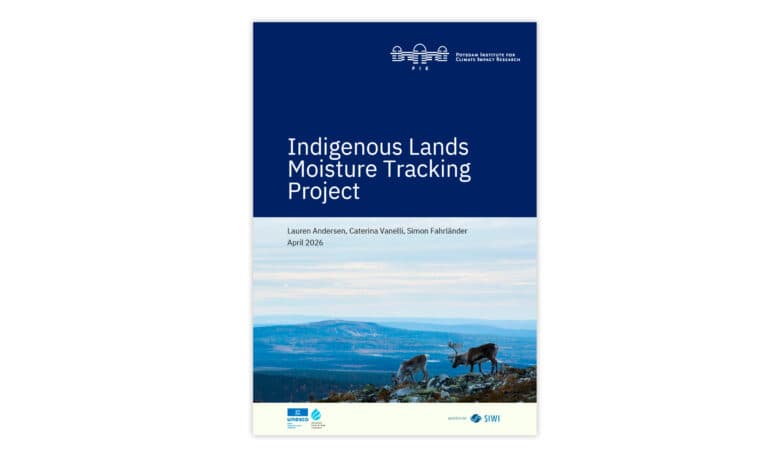
A new study commissioned by the International Centre for Water Cooperation (ICWC), a Category II UNESCO Centre hosted by SIWI, and carried out by the Potsdam Institute for Climate Impact Research (PIK) fills that gap. Using a cutting‑edge global moisture‑tracking model, researchers at PIK mapped how much rainfall around the world is sourced from Indigenous Peoples’lands—and how this varies regionally and seasonally. The results are highly relevant for policy discussions on climate resilience, water security, and Indigenous rights.
To understand the hydrological role of Indigenous People’s lands, the research team at PIK used the UTrack model, a state‑of‑the‑art system that follows individual parcels of water vapour through the atmosphere for up to 30 days, until the moisture falls as rain or snow. It works at a resolution of 0.5° x 0.5° (roughly 55 km squares) providing a global view of atmospheric moisture transport patterns.
This makes it possible to answer key questions, including:
Before running the model, the study mapped global IPL using the widely accepted Garnett et al. (2018) dataset, then refined it to focus on land areas with significant green‑water flows, excluding deserts and permanent ice where evapotranspiration is negligible (less than 84 mm/year).
The final dataset captures 31.5 million km² of IPL that actively contribute moisture to regional and global hydrological cycles.
The analysis revealed that moisture originating from Indigenous Peoples’ lands reaches every inhabited continent. Some regions receive modest contributions, but others receive hundreds of millimetres of rainfall each year sourced from IPL. Hotspots receiving >800 mm/year of IPL‑sourced rainfall include:
These are regions where forests and mountains create strong land‑atmosphere feedback loops – places where maintaining ecosystem integrity is crucial for sustaining rainfall, often over vast downwind areas.
Interestingly, the study even found a trans‑Atlantic moisture connection from parts of Africa to South America, highlighting how atmospheric rivers of moisture cross oceans.
Globally, Indigenous lands generate 13,003 km³/year of terrestrial rainfall (24.1%), while non‑Indigenous lands generate 40,895 km³/year (75.9%). The proportions are almost exactly aligned with their land area shares (26% IPL vs. 74% non‑IPL). In other words, Indigenous lands perform at least as well as non‑Indigenous lands in generating rainfall—despite enormous threats and pressures in many regions. This is a strong scientific validation of long‑held Indigenous stewardship practices that sustain ecosystem functioning.
The ET recycling ratio—the share of moisture that falls again on land instead of the ocean—is 72% on Indigenous lands and 70% on non‑Indigenous lands. Though the difference is small, it reinforces that Indigenous territories tend to maintain land‑water feedbacks that support continental rainfall and climate stability.
Dependence on Indigenous-sourced moisture varies significantly across regions. Some of the most dependent include Australia (47.9%), West Africa (40.2%), Southeast Asia (37.3%), the Tibetan Plateau (36.8%), South Asia (24.5%), and the Amazon (21.4%).
The dependence of the Amazon and West Africa is particularly noteworthy given their roles in global carbon cycles, monsoon patterns, and food security for hundreds of millions of people.
Indigenous-sourced moisture does not just fall on Indigenous territories. In North America, for example, 74% of IPL moisture falls on non‑Indigenous lands. Similar patterns appear in Europe and parts of Asia.
One of the most policy‑relevant insights comes from analyzing dry seasons, when water scarcity is most acute.
Two key patterns emerge:
In the Amazon, IPL moisture peaks during the rainy season (November–April). Contributions drop during the dry season (June–September), but remain significant, with some areas still receiving 20% or more of terrestrial rainfall from IPL.
In West Africa, a strikingly different pattern emerges. IPL moisture becomes most important during the dry season (November–February), when up to 46% of terrestrial rainfall comes from IPL—even though total rainfall volumes are low.
This suggests that Indigenous lands can act as a hydrological buffer, helping to stabilize rainfall when other moisture sources weaken. This finding has profound implications: Indigenous territories can help stabilize rainfall during critical agricultural periods when other water sources are failing. In a warming world where droughts are intensifying, this buffering function is invaluable.
The study acknowledges several limitations. The moisture-tracking dataset only covers 2007–2018, a period before many recent extreme droughts and land-use changes. The model simplifies atmospheric processes and does not simulate feedbacks, such as deforestation altering wind patterns.
IPL and non-IPL appear similar at the global scale, but this may hide important local differences in stewardship, vegetation health, and climate vulnerability. Moisture recycling is shaped not only by land management but also by broader climate drivers.
Despite these limitations, the findings offer one of the clearest global assessments to date of how Indigenous Peoples’ lands support the Earth’s hydrological system.
The atmospheric rivers carrying moisture across continents do not distinguish between political borders, land‑use categories, or economic zones, but they are shaped by ecosystems, and ecosystems are shaped by the people who care for them.
Indigenous communities have long protected landscapes that store, release, and recycle the moisture that becomes rain elsewhere. In recognizing this, policymakers can move toward a future where Indigenous rights, climate action, and water security are seen as deeply interconnected.
This study makes clear that water security is closely linked to Indigenous stewardship of land.
ICWC and SIWI will continue analyzing how these findings can inform policy water governance at multiple scales, through consultations and dialogue with relevant stakeholders.