Stay informed
SIWI newsletter
Receive SIWI’s latest news, events, reports and jobs directly in your inbox.
You can unsubscribe at any time.

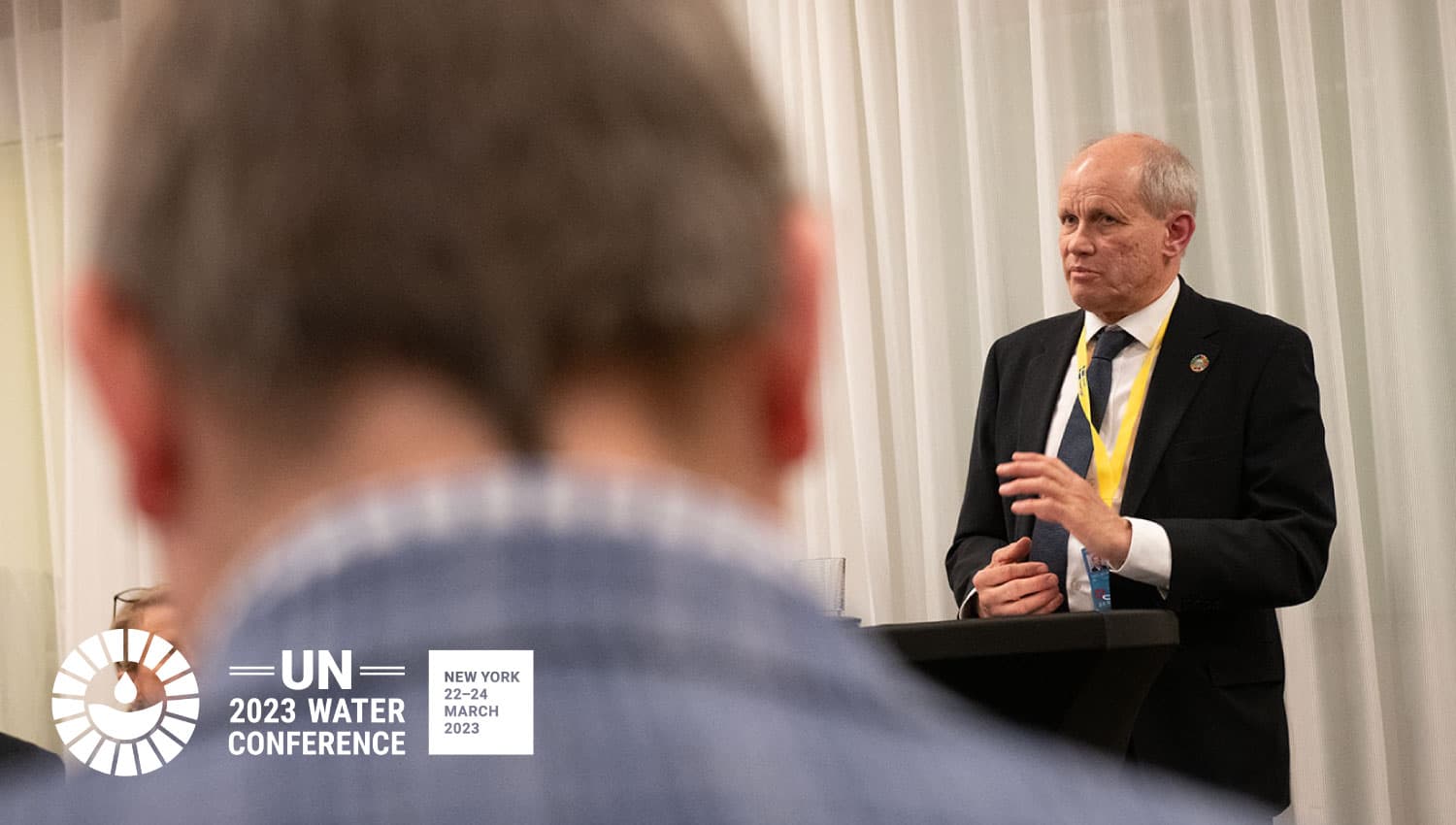
To Torgny Holmgren, addressing the global water crisis is a collective action problem and he feels that the recently concluded UN 2023 Water Conference opened a new pathway. “Of course, I wish that many governments and actors had presented strong commitments on water action to accelerate the Sustainable Development Goals, but this UN conference has hopefully set a process in motion. As co-hosts, the governments of the Netherlands and Tajikistan have raised ambitions beyond the mid-term review of the International Decade for Action Water in a way that I think will be very important,” Holmgren comments.
On the final day of the water conference, he was given the influential role of lead discussant in the concluding Interactive Dialogue 5. “We need to incentivize joint action by individuals and organizations alike. At the same time, actions must be rooted in local realities, not least to alleviate the hardship of those most in need. Linking global goals with local actions is quite difficult and complex—but that makes it even more important,” he said.
This means that the close to 700 voluntary commitments of the Water Action Agenda must be complemented by systemic transformations, and everyone has a part to play. “How water is used, managed, and valued is crucial. It is very welcome that so many people are now talking about the need for good water governance, which is at the heart of SIWI’s work. There is so much that needs to be done, at every level,” Holmgren says.
He welcomes that the Global Commission on the Economics of Water is now tasked with analyzing what needs to change in today’s governance and economics systems. Their first input is on the right track, he feels:
The Global Commission estimates that USD 200-400 billion per year is needed to achieve universal access to clean drinking water, sanitation, and hygiene by 2030. A goal long overdue, given that it was formulated already at the first UN Water Conference in Mar del Plata in 1977, with 1990 as the target year. It could still be achieved in the next seven years if harmful subsidies are phased out, making more money available for investments in improved water governance. Such investments must range from institutional development, to legislation, data availability, technical maintenance, inclusion, and behavioural change.
This is a shared responsibility, Torgny Holmgren emphasizes, and points to a growing body of research showing how the water crisis, climate change, environmental degradation and poverty interact and exacerbate each other. At the same time, many of SIWI’s activities at the UN conference demonstrated how holistic approaches such as source-to-sea management can address several of these problems simultaneously. Done right, improved management of land and water creates benefits both locally and in locations far away, for example when wetlands and forests increase carbon storage and generate rainfall over other countries.
“There is a very strong case for viewing water as a global common good. By now we know the power of water solutions, we just need to create the right incentives and innovations to untap that potential. I think World Water Week 2023 will be an important next step on this journey, not least since it will focus on innovation. Building on the UN Conference, this could be the start of a gigantic transformation,” Torgny Holmgren says.