

Indigenous Lands Moisture Tracking Project: A global analysis of terrestrial moisture recycling
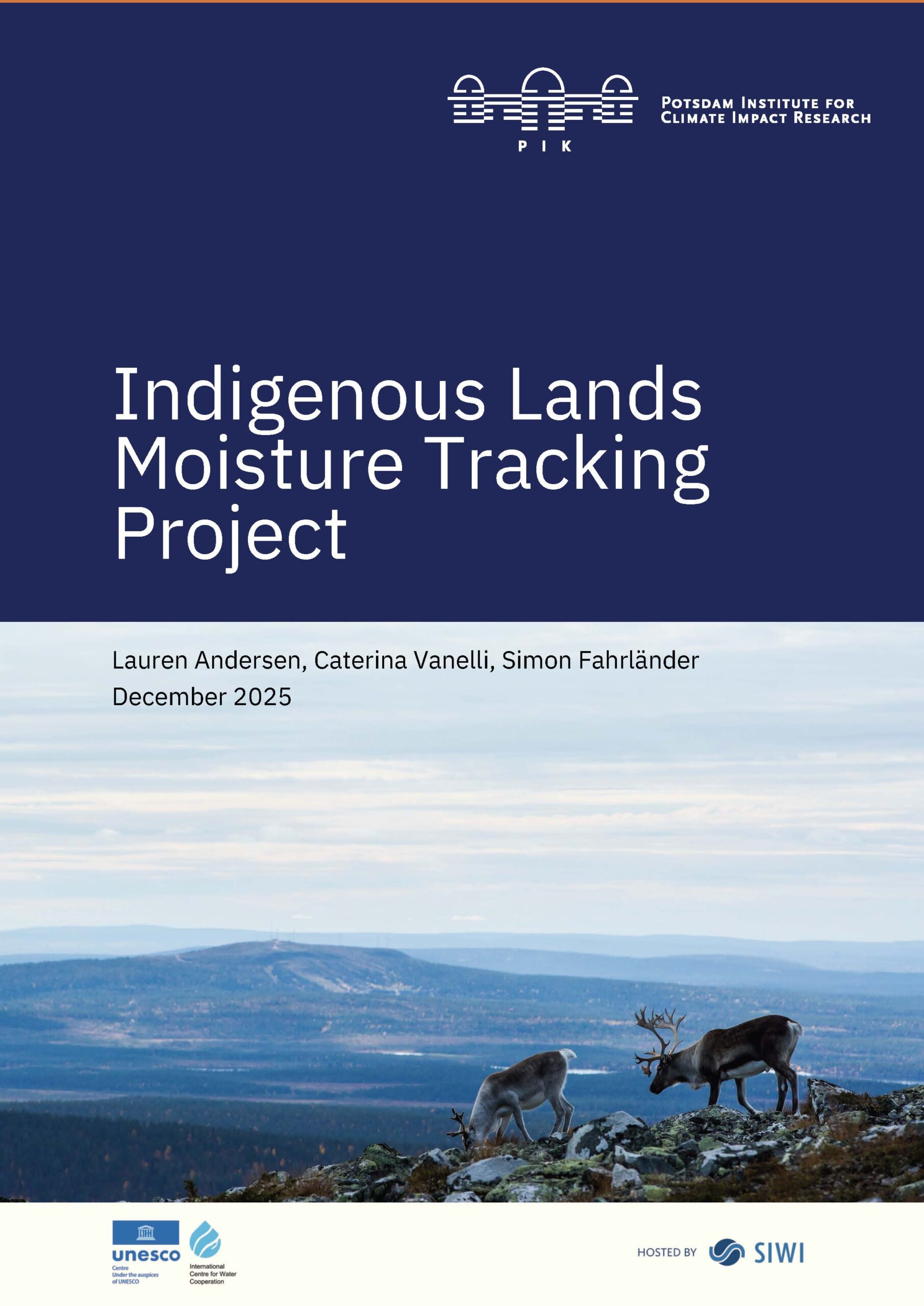
This report provides the first global analysis of how Indigenous Peoples’ lands contribute to rainfall generation and atmospheric moisture flows. Using advanced moisture-tracking modelling, it shows how ecosystems stewarded by Indigenous communities sustain rainfall patterns far beyond their borders—supporting water security, climate resilience, and ecosystem stability across regions.
This report presents one of the first global assessments of how Indigenous Peoples’ lands contribute to rainfall generation and atmospheric moisture flows. Commissioned by the International Centre for Water Cooperation (ICWC), a UNESCO Category II Centre hosted by SIWI, and developed by the Potsdam Institute for Climate Impact Research (PIK), the study applies advanced moisture-tracking modelling to quantify how water evaporated from land travels through the atmosphere and returns as precipitation.
How the analysis was conducted
Using the UTrack model, the research traces moisture flows over a 30-day period at a global scale. It identifies where rainfall originates, how it moves across regions, and the extent to which different areas depend on moisture generated from Indigenous Peoples’ lands.
Key findings
The findings show that these lands play a significant role in sustaining rainfall patterns both locally and across borders. Indigenous territories contribute nearly a quarter of global terrestrial precipitation and support hydrological processes that underpin agriculture, ecosystems, and water availability for millions of people. In several regions, including West Africa and Southeast Asia, dependence on Indigenous-sourced moisture is particularly high.
Relevance for policy and practice
The study highlights the importance of these contributions during dry seasons, when moisture from Indigenous lands can help stabilise rainfall and reduce the impacts of water scarcity. This reinforces the role of Indigenous stewardship in maintaining ecosystem functions that are critical for climate resilience and water security.
For policymakers, the report provides evidence that land management and water systems are deeply interconnected. It underscores the need to recognise Indigenous stewardship in climate and water governance, strengthen transboundary cooperation, and consider atmospheric moisture flows in decision-making.
Scope and limitations
The analysis covers the period 2007–2018 and focuses on land areas with active evapotranspiration. While it does not capture all climate feedbacks or recent land-use changes, it offers a robust global baseline for understanding how terrestrial ecosystems influence rainfall.
Looking ahead
This resource supports ongoing work by ICWC and SIWI to advance integrated approaches to water governance that reflect the full hydrological cycle, including green water and atmospheric processes.

- Transboundary Water Cooperation
- Water and climate

- Cities
- Waterfront
- Water and climate
- Freshwater and ecosystems/biodiversity
- Water and climate
- Water and energy
- Water-smart business

- Water governance
- Water and the 2030 Agenda
- Water and climate