Stay informed
SIWI newsletter
Receive SIWI’s latest news, events, reports and jobs directly in your inbox.
You can unsubscribe at any time.

The world has not managed to take decisive action to tackle the global water crisis, and many issues discussed at the first UN conference on freshwater back in 1977 remain unresolved. It is hoped that the UN 2023 Water Conference will make more people understand that we need to radically change how water is used, managed and valued.
Compared to fifty years ago we now have a much better understanding of global water challenges and the world has committed to solving many of them for example through the 2030 Agenda for Sustainable Development, adopted in 2015. But progress has been alarmingly slow, and it is the role of the UN 2023 Water Conference to get the process back on track. In particular, the conference will serve as a mid-term review of the Water Action Decade (2018-2028).
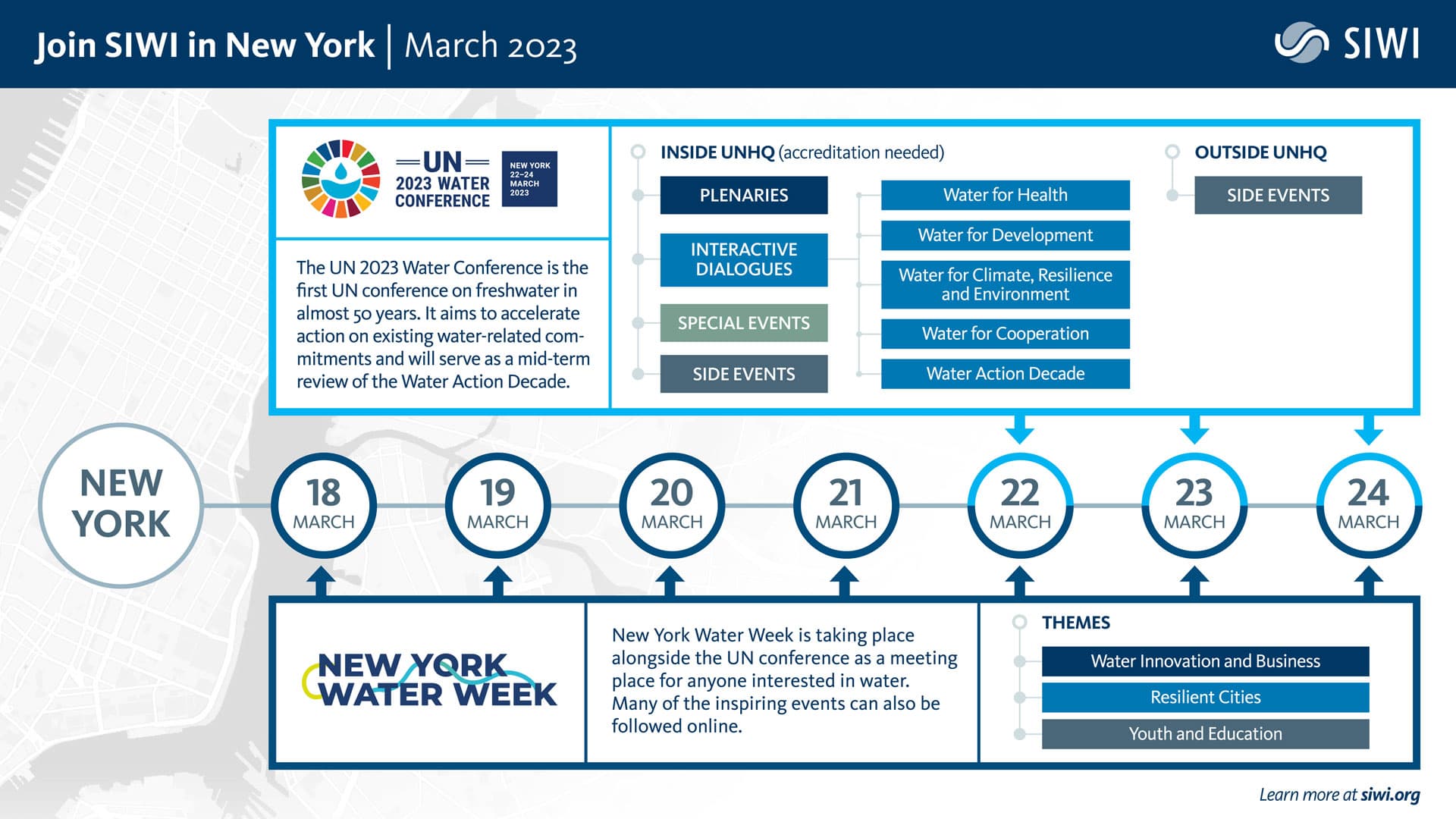
The focus of the Conference is not to negotiate new commitments but to make sure that countries deliver on promises already made and it is designed to be action-oriented, inclusive and cross-sectoral. The three days will feature an opening and closing ceremony, six plenary meetings and five multi-stakeholder interactive dialogues. There will also be several high-level special events and side events organized by Member States, the UN system and other stakeholders.
The UN 2023 Water Conference is only the beginning. The governments of the Netherlands and Tajikistan, the two co-hosts of the UN 2023 Water Conference, have launched a Water Action Agenda to provide a platform for game-changing initiatives. The aim is to fast-track water action since the world will otherwise miss many water-related goals like the 2030 Agenda for Sustainable Development. Commitments made must be tangible and action oriented. We for example need a fourfold increase in ambition to achieve Sustainable Development Goal 6 on water and sanitation, according to the Global Accelerator Framework for SDG 6.
Obviously, this is not something governments can fix on their own, all sectors of society need to be involved. Anyone can contribute to the Water Action Agenda and the initiatives from cities, regions, NGOs, and businesses will be crucial to its success.
To welcome more people to this broad movement for water, a public event called New York Water Week is organized alongside the UN 2023 Water Conference.
New York Water Week is independent from the United Nations and run by the Government of the Netherlands and the City of New York between 18 and 24 March. Activities will take place across New York as well as online on a broad range of water-related topics. Anyone can apply to host a session that forms part of the programme and the organizers hope for a vibrant mix of film screenings, art, debates, and hackathons with many sessions contributing to the Water Action Agenda.
The results of the UN 2023 Water Conference will be monitored by the United Nations and the conversations will continue at the two big meetings about progress on the 2030 Agenda for Sustainable Development that will take this year.
All actors are expected to make swift progress on their commitments to the Water Action Agenda, which will require collaboration, investments and innovation at an unprecedented scale. This year’s World Water Week, on 20-24 August, will play an important role in bringing people together to achieve this, not least since the entire conference will be focused on innovation.
SIWI has contributed actively to the consultations and preparations ahead of the UN 2023 Water Conference. A delegation of SIWI experts will participate in New York to follow the discussions on-site, lead side events and speak in sessions organized by other institutions.
Learn more about SIWI’s role in the UN 2023 Water Conference.
SIWI will also offer guidance on good water governance and provide capacity-building and support to other organizations to facilitate their implementation of commitments made to the Water Action Agenda.
Furthermore, World Water Week 2023 is centred on innovation and will have a strong focus on collaboration and knowledge sharing to achieve important water-related goals.
