Stay informed
SIWI newsletter
Receive SIWI’s latest news, events, reports and jobs directly in your inbox.
You can unsubscribe at any time.

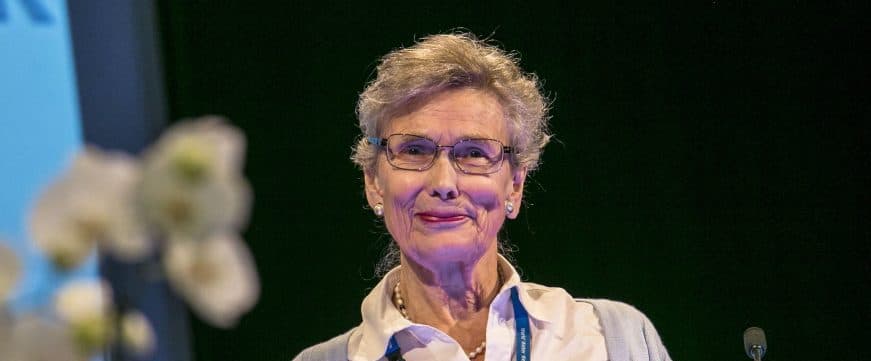
At high school, Malin was already better at Math than her teacher, going on to earn a Masters in Math, Physics, Chemistry and Mechanics before entering the field of hydrology. The biases preventing women and girls from entering the world of science mean that we are missing out on potential knowledge and research that could change the world. Decades after Prof. Falkenmark’s career began, women make up less than 30 per cent of researchers worldwide. Science and gender equality are both vital for the achievement of the internationally agreed Sustainable Development Goals. Yet women and girls continue to be excluded from participating fully in science.
Prof. Falkenmark spent much of her scientific career as an Executive Secretary of the National Committee for UNESCO’s International Hydrological Decade/Programme. It was at that time that Professor Falkenmark’s interest in the water we can’t see developed after noticing the relationship between poverty and hunger and water problems in Africa in the 1960’s. She has contributed to analyses of both global water scarcity and other environmental challenges – her research totals over 400 publications.
Her novel ideas for communicating water’s importance, such as seeing water as the bloodstream of the biosphere, in addition to her wide-ranging activities for making the world more sustainable, have had an enormous impact on today’s thinking for solving environmental problems.
In 2018, Falkenmark was awarded the Blue Planet Prize for “[placing] water problems onto the global policy agenda”. The prize goes to outstanding individuals or organizations whose work have and continue to contribute significantly to the improvement of the global environment. What did she do with the prize money? She used it to create a youth workshop during 2019’s World Water Week, empowering our Stockholm Junior Water Prize finalists to collaborate on a joint statement on climate change. A statement which called for ”investments in education and research are paramount to bringing the necessary innovations to reality in order to overcome today’s and tomorrow’s challenges”. SIWI was proud to take this statement to the UN General Assembly and the climate summit COP25 as part of our commitment to youth empowerment.
Malin Falkenmark’s dedication and passion for research and advocacy has changed how we see water, and her relentless championing of youth engagement and education will ensure that her knowledge will be used for generations to come. As food security becomes increasingly threatened by the effects of climate change – her research will save lives.
Here are just a few examples of Prof. Falkenmark’s agenda setting research:
Read more on page 7 of Waterfront
“Stationarity is Dead” (2008) changed how water management was perceived. Water had, for too long, been considered a reliable and predictable resource. This article showed how global warming, with other factors, impacted the ‘reliable’ water cycle demanding a complete rethink of how we manage water resources.