Stay informed
SIWI newsletter
Receive SIWI’s latest news, events, reports and jobs directly in your inbox.
You can unsubscribe at any time.



SIWI just published three documents aimed at helping decision makers, organizations and practitioners to apply a source-to-sea approach in their work.
The Vu Gia-Thu Bon River Basin in central Viet Nam covers an area of 10,350 km2 and is home to Hoi An, an ancient town and UNESCO World Heritage site. The Cu Lao Cham islands are just offshore; these are both important tourist destinations. In Viet Nam, plastic pollution has skyrocketed on the political agenda at the national level as well as in Hoi An and Quang Nam Province, making the situation ripe for applying the source-to-sea approach to preventing plastic pollution.
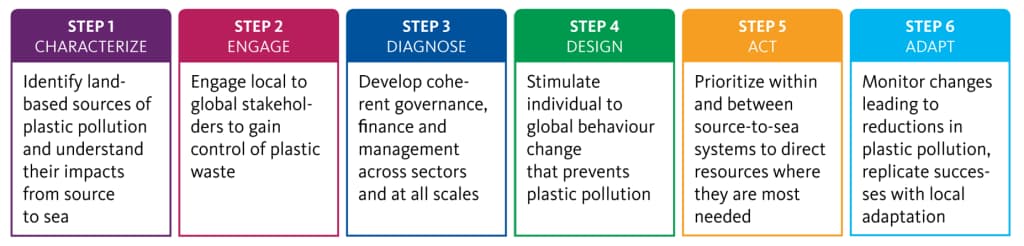
SIWI implemented two projects, Foundations for Source-to-Sea Management and Design and Accountability for Source-to-Sea Action on Plastic. Both projects applied the Source-to-Sea Framework for Marine Litter Prevention, which is built upon the six-step source-to-sea approach. Taken together they provide ample evidence of the strengths of this approach in engaging a wide range of stakeholders and the benefits of incorporating source-to-sea perspectives in planning processes.
Halting the flow of plastic pollution into waterways and the ocean requires a broad range of stakeholders. We must collectively make the necessary changes in waste and wastewater management and the life cycle of plastic goods. Understanding the relationships between actors and their interdependencies can support analyses of what is working and where there are gaps, barriers, lack of incentives, or opportunities for taking appropriate actions.
To stimulate collaborative action to prevent plastic pollution in Hoi An, SIWI along with its local partner, IUCN Viet Nam, brought together stakeholders from local government authorities, private sectors, informal sector, and civil society organizations. Together, we built a common understanding of their specific roles within the plastic waste value chain. By clarifying their individual responsibilities and the interdependencies among stakeholders, we were able to identify regulatory, community and infrastructure actions that would contribute to preventing plastic pollution.
Collaborating on these actions requires accountability across different actors.
Read more about a source-to-sea accountability framework for preventing plastic pollution.
Planning processes for cities or larger urban areas often focus on activities that occur within their jurisdictions. However, they can be affected by and/or have impacts on the entire source-to-sea system they reside within. Including source-to-sea perspectives in urban and regional planning means that these geographic and sectoral linkages within a source-to-sea system are included in, and inform interventions, investments, and policies. This can also lead to the definition of objectives, activities, and goals that explicitly provide benefits and co-benefits across multiple sectors or geographical segments.
Responding to a request from the Hoi An City Peoples Committee and the Department of Natural Resources and Environment, SIWI provided support in developing a five-year environment strategy using the six-step source-to-sea approach. Through active engagement with the strategy writing team, the source-to-sea approach was applied for the issue areas covered by the environment strategy – landscape, greenery, wastewater, solid waste, and clean energy, over three activities:
This was the first time the source-to-sea approach was used in environmental strategy development and its benefits included the identification of co-benefits from proposed actions and elaboration of a robust monitoring and evaluation system.
Source-to-sea challenges are inherently complex, needing coordination between different sectors and cooperation between upstream and downstream actors to build a coherent approach to addressing the challenge. The six-step source-to-sea approach is a structured process for developing shared understanding, a common vision, and an action plan to get there. Engaging stakeholders in this process will lay the groundwork needed to cultivate coordination.
The pilot projects tested the source-to-sea approach at the river basin and municipal levels and was applied to plastic pollution prevention as well as to environmental strategic planning. The source-to-sea approach proved helpful in structuring the discussion between diverse stakeholders such that they could come to a common understanding of the issues and identify a shared vision of the future that they could work together on achieving.