Stay informed
SIWI newsletter
Receive SIWI’s latest news, events, reports and jobs directly in your inbox.
You can unsubscribe at any time.


“How do people living downstream get their voices heard?” For KTH master’s student Abbhilash Ramakrishnan, the question comes from experience. Growing up in a downstream state, he saw how difficult it could be to get fresh water. Working on the simulation has made him think about how governments consider the people affected by decisions over shared rivers.
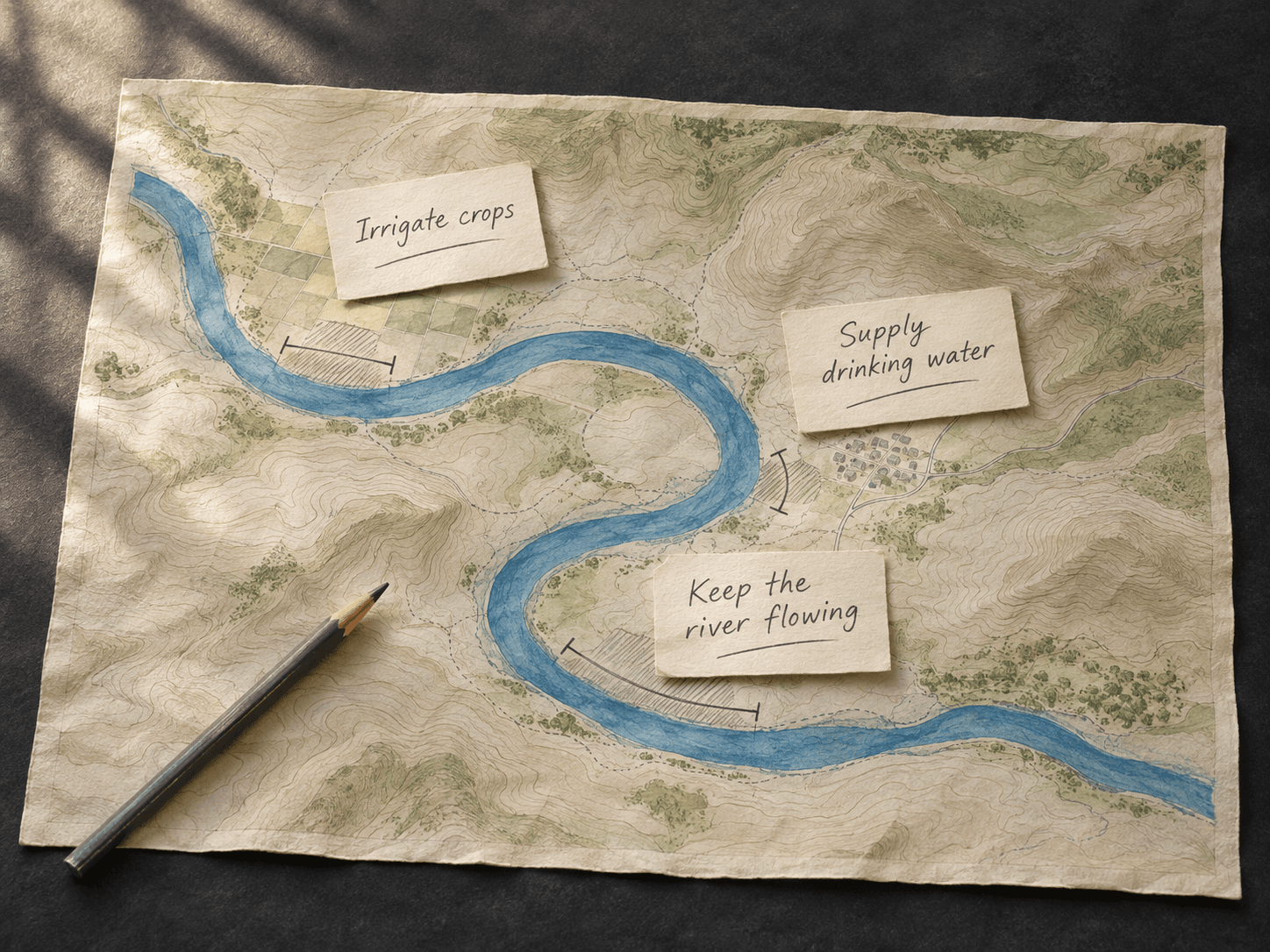
Political priorities and economic interests shape what parties can agree on. So do historical relationships and differences in power. The simulation gives participants a chance to work through these dynamics and reflect on the decisions they make along the way. How did they define the problem? Who did they involve? What helped the talks move forward, and where did they stall?
The new simulation builds on the Routledge Handbook of Water Diplomacy and SIWI’s experience facilitating dialogue and delivering training. It will replace role-play exercises that SIWI developed in 2005. SIWI plans to run the new exercise in person and offer an AI-supported digital version that participants can use in multiple languages.
Abbhilash Ramakrishnan, Filip Andric, Bhargav Joshi and Weiyin Fang are working with SIWI specialists to build the digital prototype. One of their design questions is what information each person should see during a negotiation. “In software I call that ‘who can see what’, but here it is also a question of trust and politics,” says Weiyin.
Bhargav is designing the screens that participants and facilitators will use to follow the exercise. He’s thinking about how to give people enough information to decide what to do next while keeping the screen easy to follow.
SIWI will test and refine the training and simulation through pilots in Stockholm, Sweden, and with regional partners, including in the Middle East and Central Asia. SIWI will observe how participants work through the exercise and use their feedback and learning assessments to improve it. A simulation exercise involving at least 50 participants is also planned for World Water Week 2027.
SIWI will train facilitators in Amman (Jordan), Tashkent (Uzbekistan) and Brussels (Belgium) so partner institutions can run the exercise and adapt it to their own contexts. The final simulation and facilitation guidance will be publicly available.
Initiated by the International Centre for Water Cooperation, Actionable Water Diplomacy runs from June 2026 to September 2028 with support from the Swedish Postcode Lottery Foundation.