Stay informed
SIWI newsletter
Receive SIWI’s latest news, events, reports and jobs directly in your inbox.
You can unsubscribe at any time.

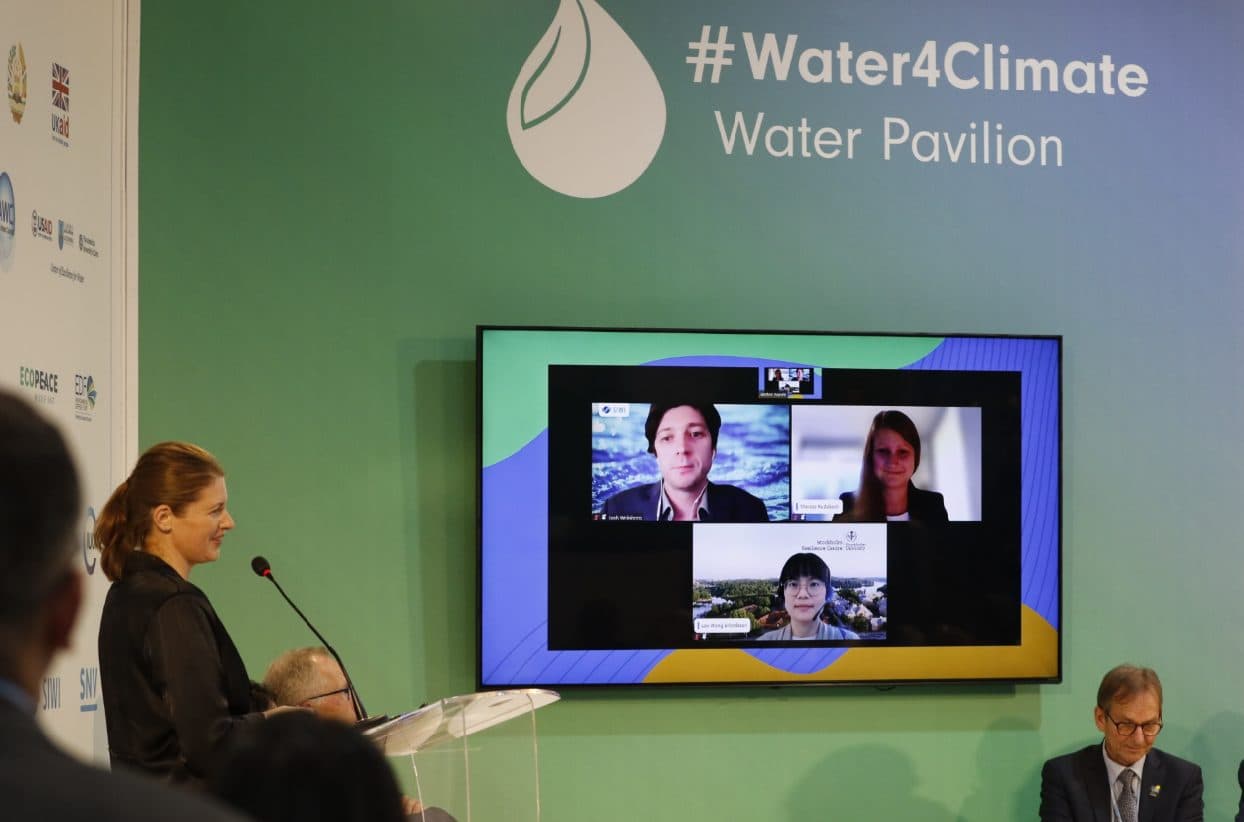

In her welcoming remarks, UNDPs Srilata Kammila underlined the severity of the situation “we are nowhere near the scale needed to reduce emissions”. She warned that on the current path “potentially our financial resources and technology are not going to be enough”, and further emphasized that “water is critical to alter our course with respect to climate change”.
Keynote speaker Johan Rockström kicked off his speech by stressing how freshwater challenges are connected to major global crises such as climate change, ecological challenges, the Covid-19 pandemic and violent conflict. Global warming leads to changes in the hydrological cycle which results in increased floods and droughts and heavily impacts livelihoods and economies.
However, water is not only part of the challenge, but vital for mitigation solutions that work. Factoring water into mitigation planning can offer vast opportunities for climate mitigation but can also help avoid major risks and unrealistic planning. One reason for this is that most mitigation measures are dependent on access to freshwater resources, which is, however, increasingly uncertain. This is one of the challenges that need to be factored in to make sure climate mitigation can work.
The report gathers the latest science on the key role of water in mitigation and showcases how water smart climate mitigation can look across major sectors and how sustainable water management can reduce emissions.
SIWI’s Malin Lundberg Ingemarsson led the report and proudly said “Now it’s time to give my baby wings”, before thanking the large number of contributors. After the launch, one party representative emphasized: “We can learn so much from this report. We need to bring this knowledge to the negotiations”. The global launch of the report will be followed by a series of webinars in the run up to the United Nations Conference on Water in March 2023.
Eagerly anticipated, well received
Colleagues and peers expressed their excitement and anticipation for reading the report, with one follower on LinkedIn commenting: “Water security is at the centre of climate change mitigation, adaptation and biodiversity protection and must be emphasised equally by various stakeholders.” On Twitter, Stockholom University’s Baltic Sea Centre noted: “Better management of water is critical to tackling today’s food and energy crises, both of which are exacerbated by climate change.” Kezia Saunders from the Rivers Trusts summed it up perfectly: “Freshwater is our ally in climate action”. The report also received coverage in the Water Diplomat.
SIWI’s Malin Lundberg Ingemarsson led the writing of the report and the editorial team which was made up of SIWI’s Josh Wienberg, WaterAid’s Dr Thérèse Rudebeck and Dr Lan Wang-Erlandsson from Stockholm Resilience Centre.
The report was a feat of collaboration between SIWI, Stockholm Resilience Centre (SRC), The Potsdam Institute for Climate Impact Research (PIK), United Nations Development Programme (UNDP), German Corporation for International Cooperation (GIZ) and Federal Ministry of Economic Cooperation and Development of Germany (BMZ)